7 things the VALORANT Champions Shanghai group stage revealed about the 2026 meta
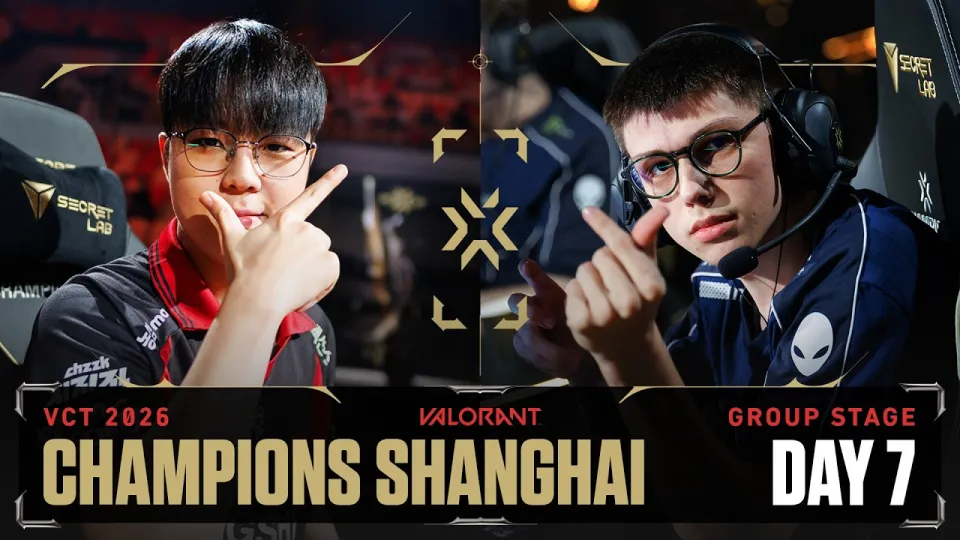
Video: VALORANT Champions Shanghai — Group Stage — Day 7
Need articles like this for your video? They help promote it on YouTube and Google — order them in the Telegram bot @sat_sit_bot. It writes articles around your video, embeds the video and publishes them on popular niche websites (no ads). Free trial — 50 articles.
Key takeaways
- Champions Shanghai runs September 24 to October 18 with 16 teams from Americas, CN, EMEA and Pacific.
- Group Stage Day 7 aired on the VALORANT Champions Tour channel on October 1.
- Two different Masters winners in 2026 mean no single team entered Shanghai as the clear favorite.
- Viewers flagged repeated technical pauses as a recurring disruption across the broadcast.
- Chinese teams drew heavy criticism for losing eco rounds and 5v2 situations in group play.
VALORANT Champions Shanghai is the final stop of the 2026 VCT season, where 16 teams from Americas, CN, EMEA and Pacific fight for the world title between September 24 and October 18. Group Stage Day 7, published by the VALORANT Champions Tour on October 1, captures the moment the bracket started to separate contenders from passengers. For anyone tracking the meta, the official VALORANT Esports hub on X remains the fastest place to get schedules, results and bracket updates as the event moves toward playoffs.
What the Champions Shanghai format actually asks of teams
The tournament gathers 16 squads across four regions, and the group stage is where depth gets tested rather than star power. Two different Masters events in 2026 produced two different champions, which means Shanghai arrived without a single dominant favorite and with several rosters believing the trophy is open. That framing matters: group-stage VALORANT rewards teams that can absorb a bad map, reset mentally and win the next one, not teams that peak once. With a field this tight, map-veto discipline and pistol-round conversion often decide who advances and who books an early flight home.
1. Two Masters winners changed how groups were seeded
Having two separate Masters champions in one season scrambles the usual hierarchy. Teams that won earlier in the year carry target on their backs, while challengers from other regions arrive with nothing to protect. In practice, that produces group tables where a single upset reshuffles everything, and it makes round differential a live concern from the first matchday. The description of the broadcast frames the event exactly this way: familiar names, new contenders and a fearless generation of challengers competing for the biggest trophy of the year.
2. Tech pauses became the story nobody wanted
Repeated technical pauses disrupted the flow of Day 7 and drew more viewer frustration than any individual play. Long stoppages break momentum in a tactical shooter more than in most esports: a team that has just lost two rounds gets an unwanted reset, and a team riding a hot streak cools off. For viewers catching the VOD, the practical advice is to use the spoiler-free timestamp comments that the community maintains under the broadcast, since the pauses stretch the runtime well beyond a normal match block.
3. Chinese teams were punished for losing unlosable rounds
The harshest criticism of the group stage landed on the CN representatives, and it was specific rather than generic. Fans pointed to lost eco rounds, blown 5v2 advantages and utility usage that collapsed once set strategies stopped working. Those are the exact failure modes that separate regional play from international play: opponents scout your defaults, force you into improvised mid-round calls, and punish passive setups. A team that cannot win a save round or convert a man advantage gives away maps it otherwise controls.
4. Eco rounds and 5v2s are the real group-stage currency
Winning the rounds you are supposed to lose is the cheapest path to a playoff spot. A converted eco round is worth more than a highlight reel ace because it breaks the opponent's economy for two or three subsequent rounds. The same logic applies to 5v2 retakes: teams that hesitate, over-rotate or stack the same angle let a two-man clutch snowball into a momentum swing. Across Day 7, the gap between teams was less about aim and more about discipline in exactly these low-margin situations.
5. Utility creativity is now a scouting report item
Predictable setups get read instantly at Champions level. Critics of the CN performances noted a lack of creativity once scripted executes failed, and that observation applies to every region. The teams that look comfortable in group play are the ones with secondary defaults, flexible sentinel placement and at least one player willing to improvise off a broken execute. A Yoru clone bluffing a site hold, the kind of moment viewers clipped from the broadcast, is a small example of the mind games that decide close maps.
6. Regional depth is deeper than the bracket suggests
One recurring complaint under the broadcast argued that stronger teams from other regions were left out of Champions entirely. Whether or not that is fair, it points at a real structural issue: qualification paths concentrate slots, and the group stage does not always feature the 16 best rosters in the world. For viewers, that is a reason to watch the regional leagues rather than only the international events, because the next breakout contender usually appears there first.
7. What Day 7 says about the playoff picture
Group Stage Day 7 is the point where scorelines start telling the truth. Teams with clean pistol records and converted ecos control their own destiny; teams relying on one comfort map need a veto miracle. The 2026 season has already produced two Masters champions, so the playoff bracket in Shanghai is likely to reward the roster that adapts fastest between maps rather than the one with the loudest regular season. Watching how teams handle a loss, a pause and a bad half is a better predictor than any single stat line.
Useful links
- Official VALORANT Esports news and schedules: https://www.valorantesports.com
- VALORANT Esports on X: https://x.com/valorantesports
- Facebook: https://www.facebook.com/ValorantEsports/
- Instagram: https://www.instagram.com/valorantesports/
- TikTok: https://www.tiktok.com/@valorantesports
- Twitch: https://www.twitch.tv/valorant
- YouTube: https://www.youtube.com/@ValorantEsports
- Kick: https://kick.com/valorant
Final thoughts on the Shanghai group stage
Champions Shanghai is doing what a world championship should do: exposing which teams can win ugly. Converted eco rounds, disciplined 5v2 retakes and composure through long technical stoppages separated the field on Day 7 far more than raw firepower. With two Masters winners in the same bracket and a CN contingent still searching for answers, the playoff seeding is wide open. The full Day 7 broadcast and the rest of the group stage are available on the VALORANT Champions Tour channel, and following VALORANT Esports on X is the simplest way to keep up with results, brackets and match schedules as the event heads toward the final.
Source: VALORANT Champions Shanghai — Group Stage — Day 7 · Markdown version
Questions & answers
What is the VALORANT Champions Shanghai format?
Sixteen teams from Americas, CN, EMEA and Pacific compete for the 2026 world championship, with the event running from September 24 to October 18. The group stage filters the field before playoffs, and map differential matters because the bracket is tight. Day 7 of group play was broadcast on the VALORANT Champions Tour channel on October 1.
Why were there so many technical pauses on Day 7?
The broadcast was interrupted by repeated technical stoppages, and viewers reacted with visible frustration in the comments. Pauses reset momentum in a tactical shooter, so they can shift the flow of a series. For VOD viewers, community-maintained spoiler-free timestamps are the practical workaround.
Why did the Chinese teams struggle in the group stage?
Viewers pointed to lost eco rounds, blown 5v2 advantages and utility usage that fell apart once set plays were scouted. Those are the classic signs of a team that relies on scripted executes without flexible mid-round adjustments. At international level, opponents punish exactly that predictability.
Is the group stage a reliable predictor of the Shanghai champion?
Not on its own. With two different Masters winners in 2026, no roster entered Shanghai as a clear favorite, and group results mostly show which teams convert low-margin rounds. The stronger signal is how a team resets after a lost map or a long pause, which matters more in playoffs.